
Today’s masters of supercomputing were once yesterday’s newbies—which is why preparing the next generation is a crucial part of the field’s development.
The awards €1,500 each to two lucky recipients along with free registration for the . We wanted to know more, so we caught up with this year’s awardees: of Nepal and of Botswana.
Why were you selected to attend the ISC18 conference?
Raksha Roy: I’m working as a developer at the in Nepal, and I did my master’s in computer information systems. I came across HPC while researching thesis topics and ended up working on Weather Research and Forecasting (WRF) benchmarking. My motivation and passion for HPC is well realized by the ISC conference. I’m so glad to have this opportunity to mingle in this vast network.
Badisa Mosesane: I was selected for this conference because of my keen interest in high-performance computing. I made very clear my reasons as to why I wanted to attend this conference: a basic need to gain skills in high-performance computing and then, with my freshly gained knowledge, go back to my university and train other students to try to excite them into doing high-performance computing.
What interests you about HPC?
 Roy: It's the absence of HPC in my country that drove me into the topic. While I was doing my thesis in HPC, I had to really struggle due to a lack of human capital and also resources. I want to take this topic, and I want to introduce it, vastly, into my nation.
Mosesane: The thing that interests me about this field is the capacity of HPC to accelerate research. When you’re using supercomputers and clusters in a job that should take you thirty hours, HPC lets you do it in thirty seconds.
Any advice for other young people who want to get into HPC?
Roy: HPC has simplified any process that has a lot of data coming in and requires a lot of computational power. So, without HPC, completing these tasks won’t be so easy. If we can have a lot of people involved with HPC and create a big circle of people doing the same thing, it will be easier to work together.
 Mosesane: My advice to young people who are willing to commit to HPC: start small, and then grow. Look into gaining access to one of the supercomputers or HPC clusters and try to work on small projects. For example, run simple MPI message-passing programs and open MP programs. Then, on top of that, try to find people who are experts in high-performance computing.
What’s next for your careers?
Roy: I want to pursue my higher education in HPC. So perhaps my PhD in HPC or getting to research in HPC.
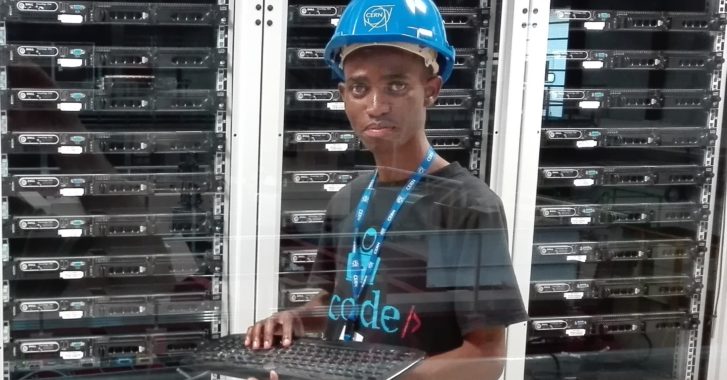
Mosesane: I see myself going into studying for my PhD in HPC to help answer some of the big questions. I’ve had the opportunity to work at CERN and I see the benefits in terms of artificial intelligence playing a role in helping them understand new physics.
What’s been your favorite part of ISC?
 Roy: Meeting a lot of people. Every person you meet is someone who can deliver new things. It’s such a great opportunity, especially for networking, and we are very thankful to the ISC conference for having us here because this is one of the greatest opportunities in my life.
Mosesane: We get a lot of value from the different presentations demonstrating current challenges in HPC. We're being challenged to figure out the direction which we have to go in order to solve these problems. It's really an honor to meet with such great people. I'd just like to encourage other young people who want to attend the ISC conference to go ahead and apply. You have the potential to be selected just like us.
