
This week we talk nerdy about honey in Nigeria, a surprising use for squid protein, industries that are killing us, and more.
Beehive management
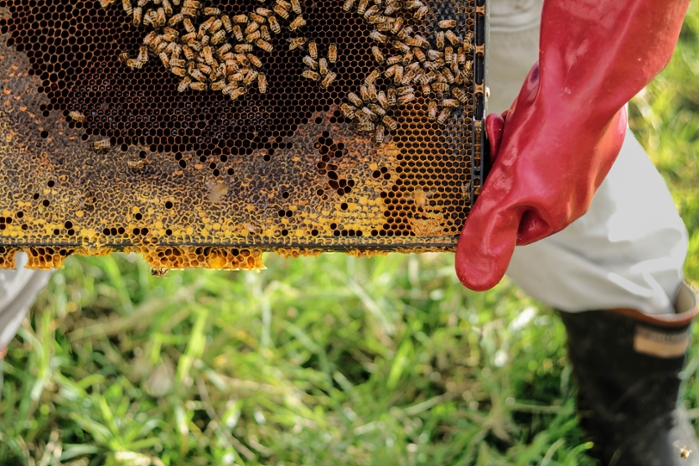 There’s a lot of buzz about bees these days. (Get it?) In January, we shared a story about bees wearing backpacks to gather weather data. Our last Talk Nerdy featured bees calculating math problems. This time the bee story is about artificial intelligence, honey production, and economics in Nigeria.
and his company, have developed a system beekeepers can use to monitor hive activity and maximize honey production. Umanah says that a beekeeper’s biggest problem is bees abandoning the hive.
Honeyflow Africa’s system uses equipment supplied by the US company . This includes a monitoring device and smartphone app called Buzzbox. The app gives beekepers data on buzz frequency (yes, that’s a thing), number of idle worker bees, and other hive business. The hope is that better beehive management will lead to increased honey production for Nigeria and a way to reduce poverty in the nation.
Plastic from the deep
Plastic waste in the Earth’s oceans is a problem . Back in July we ran a story about researchers who are using supercomputers to design a mutant enzyme that eats plastic bottles. Cleaning up the that are currently in the ocean is the first step. Reducing our reliance on plastic must come next.
 and his team of researchers at are investigating ways to make environmentally friendly alternatives to plastic from proteins found in squid. These squid ring teeth proteins (SRT) are biodegradable and can be produced using genetically engineered bacteria. No freaky underwater creature required!
is self-healing, flexible, and strong. The plastic substitute could be used to make a recyclable fabric that is resistant to washing machine damage. Another possible use is clothing that would protect against chemical and biological warfare agents. Synthetic SRT currently costs around $100 per kilogram to produce, but Demirel hopes to bring the price down to a tenth of that.
The price of prosperity
Depending on who you talk to, is either the solution to poverty or an incentive for people not to work. For now, if you want a reasonably comfortable life, you must have a job (or two, or three). But what if we consider the possibility that some industries that provide jobs also do harm to the public?
 , a professor examined two case studies focused on . He worked under three assumptions: everyone has the right to life; everyone has the right to work; and human law should grant corporations the right to exist only if they benefit humanity.
He found that while the coal industry employs 51,795 people in the US, the number of premature . The record is even worse for the US tobacco industry which employs 124,342 people, but kills 522,000 through direct and second-hand smoke.
In a , Pearce and his team demonstrated that tobacco farmers would benefit economically by converting their land to solar farms. Pearce hopes that standards for corporate accountability can be identified for other industries.
Better blood tests
Early detection of certain cancers can improve patient outcomes. Commercial approaches to detecting small quantities of ultrasensitive proteins that signal these cancers are growing but most are available only in laboratory settings.
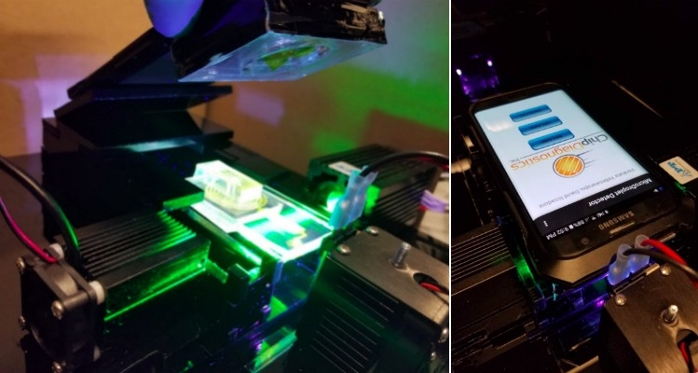 , assistant professor of bioengineering at the , and grad student have developed than the standard tests and much less expensive.
The researchers use a standard cellphone camera and a set of strobing LED lights along with their lab’s generators. The system is able to identify the presence of relatively few proteins in a vial of blood, whereas a traditional test would not be able to tell the difference between a vial that contained the proteins and one that did not.
On its own, a cellphone camera is too slow to capture individual droplets as they pass through the digital detector, but the addition of a light source that strobes one thousand times faster than the camera’s framerate makes it work.
Digital pig farms
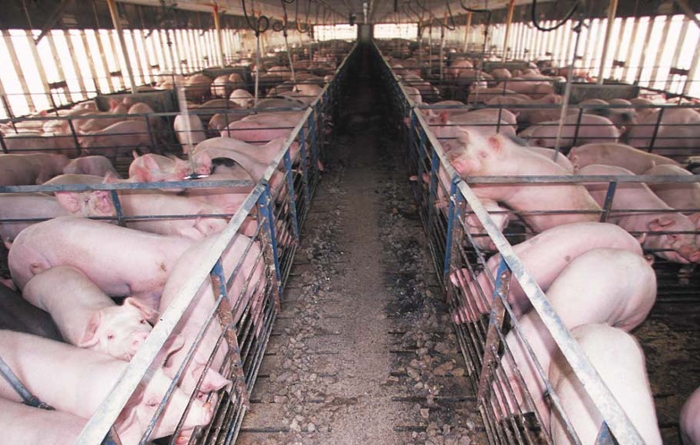 With a deadly swine disease killing off pigs in China, tech companies are developing ways to help farmers protect their animals. A recent for Chinese economic development calls for .
Tech companies say they can help farmers quarantine disease carriers, reduce feed costs, increase fertility, and reduce premature deaths. Technologies include pig facial recognition, voice scans that can detect a potentially contagious cough, and robots that calibrate and dispense food.
But many who work on China’s 26 million small pig farms in China are skeptical of the high-tech approach. It costs about seven dollars to map a pig’s face versus $0.30 to tag its ear, but Wang Lixian, a research fellow at the , expects the price of these technologies to drop and their use to increase.
