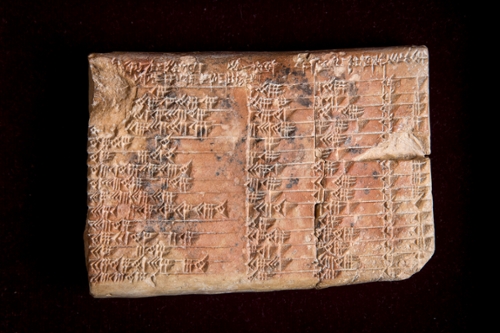
- Plimpton 322 tablet mystery solved
- Ratio-based trigonometric table revealed
- Mathematicians credit computer literacy and algorithms for the find
A 3,700-year-old clay tablet fragment and a handful of algorithms has just upturned the history of intellectual progress.
Unearthed in the south of present day Iraq, a remnant of an ancient Babylonian clay tablet called Plimpton 322 is thrilling scholars again. The fragment is small, containing a four column, 15-row table of numbers written in cuneiform.
It has been interpreted in many ways, but an exciting reading out of the posits the fragment as an ancient and simple form of trigonometry.
This bright new take is receiving a lot of international attention, not least for its upending of the known history of mathematics.
What has not been widely disseminated is how arrived at his thrilling discovery.
Mansfield and his co-author, associate professor from UNSW Sydney, are first to . To understand why this is significant we must recall the basis for our Western (Grecian) mathematical heritage.
Our better angles
The tradition of trigonometry (triangle measuring) is bound up with our penchant for star-gazing. Ancient thinkers sought to determine angular motion based on the rotation of the earth and to predict the location of stellar bodies.
Following this tradition, we use an angle to determine the shape of a right triangle and understand the ratios of the sides as circular functions (sin, cos and tan).

did not have the notion of circular function. Instead they used ratios such as the ukullû, (‘run over rise,’ or reciprocal slope), Mansfield notes. The same measurement features prominently in Egyptian mathematics.
By conceiving of right triangles as half of a rectangle and using a sexagesimal number system (like the minutes in an hour), Babylonians could arrive at precise triangle measurement.
The absence of angles means that Plimpton 322 is not useful for astronomical calculations. But it is surprisingly powerful when it comes to measuring right triangles, and even compares favorably to much later tables such as from the 15th century AD.
“The breakthrough was, in part, made possible by a numerical library that I wrote to perform sexagesimal arithmetic. By actually doing the Babylonian procedures myself (with the computer to assist) I was able to see some of the subtleties that others had missed,” he says.
Mansfield used these algorithms to test the longstanding hypothesis that Plimpton 322 was a description of solutions to a certain type of quadratic problem.
It was not advances in hardware that enabled this discovery, it was advances in education that made this possible. ~ Daniel Mansfield
Performing the calculations for each row, he noticed that some of the operations were uncharacteristically complex, particularly those in row four, where the square root calculation turned out to be impossible to perform using Babylonian techniques.
This realization showed the prevailing hypothesis about Plimpton 322 was flawed, opening the door for a trigonometric interpretation.
Despite his facility with algorithms and the breakthroughon a puzzle that has stymied mathematicians for at least 70 years, Mansfield insists his predecessors could have seen what he has if only they had the computer literacy.
“The numerical complexity of sexagesimal calculation makes it cumbersome to perform by hand,” Mansfield says. “But you need to make these calculations to thoroughly test a hypothesis, and modern computer literacy made this feasible. So, it was not advances in hardware that enabled this discovery, it was advances in education that made this possible.”
Daze of future past
Mansfield dubs the Babylonian approach to trigonometry BEST (Babylonian Exact Sexagesimal Trigonometry), but this is no hyperbole. He believes that this alternative view based on ratios can be taught alongside the traditional angle based approach, and thereby enrich the study of trigonometry in school by looking at triangles from different cultural perspectives.
Mansfield also sees great potential for this Babylonian approach in computing. The old Cray supercomputers once performed division using a Babylonian reciprocal table, and now we have a similar approach for trigonometry.
“A modern implementation of these ideas would not meet the for accuracy, so this approach is not going to revolutionize floating-point arithmetic,” admits Mansfield, “but it would be efficient and very fast, so it may be useful for applications where energy consumption or speed are integral to success.”

Applications aside, the rewriting of intellectual history is no small feat. It should cause a major rethink of theories of progress and a reflection on knowledge lost to the ages.
3,700 years have come and gone, but this old clay fragment has a lot to teach us about something we thought we already knew.
“Perhaps the best we can hope for is to use history as a mirror to reveal parts of Western culture that are deeply embedded. Measuring triangles through the angle has been lodged within mathematics for a long time, and without the Babylonians we would probably never have had reason to think differently.”
More background about trigonometry from UNSW .
What to learn more? Take a deeper dive with professors Mansfield and Wildberger in this video explainer series.
