
- Some of the underlying processes of photosynthesis are still not understood.
- A multinational team is working on simulating the ‘light-harvesting complex’ (LHC II), a complex of chlorophyll molecules and proteins essential to photosynthesis, on a quantum level using different supercomputers.
- The team has successfully simulated 6,025 atoms of the LHC II, and is working towards simulating the full 17,000 atoms that comprise the LHC II.
An international team, led by researchers from the , has conducted detailed simulations of the processes behind photosynthesis. Working in collaboration with several other universities and institutions, the researchers are using supercomputers to better understand how photosynthesis functions at the most basic level.
Photosynthesis is fundamental to much life on earth. The process of converting energy from our sun into a chemical form that can be stored enables the plethora of plant life that covers the globe to live. Without photosynthesis, plants — along with the animals that depend on them for food and oxygen — would not exist. During photosynthesis, carbon dioxide and water are converted into carbohydrates and oxygen. However, this process requires energy to function; energy that sunlight provides.
Over half of the sunlight that green plants capture for use in photosynthesis is absorbed by a complex of molecules and proteins called the . Yet the scientific community still does not fully understand how this molecule acts when it absorbs photons of light.
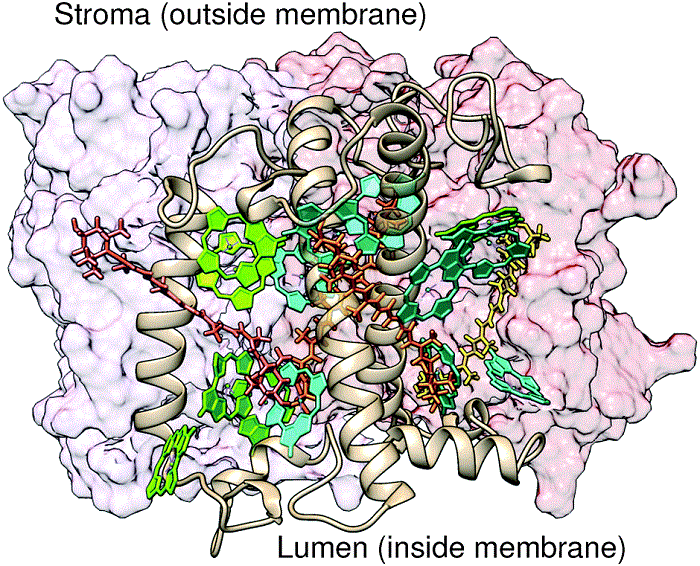 To help illuminate this mystery, the team at UPV/EHU is simulating the LHC II molecule using a quantum mechanical theory called , implemented in a special called ‘Octopus’. Simulating LHC II is an impressive feat considering that the molecule is comprised of over 17,000 atoms, each of which must be simulated individually.
Because of the size and complexity of the study, some of the TDDFT calculations required significant computing resources. Two supercomputers, and , played an important role in the experiment. Joaquim Jornet-Somoza, a postdoctoral researcher from the , explains why: “The memory storage needed to solve the equations, and the number of algorithmic operations increases exponentially with the number of electrons that are involved. For that reason, the use of supercomputers is essential for our goal. The use of parallel computing reduces the execution time and makes resolving quantum mechanical equations feasible.” In total 2.6 million core hours have been used for the study.
However, to run these simulations, several issues had to first be sorted out, and the Octopus software code had to be extensively optimized to cope with the experiment. “Our group has worked on the enhancement of the Octopus package to run in parallel-computing systems,” says Jornet.
The simulations, comprising of thousands of atoms, are reported to be the biggest of their kind ever performed to date. Nevertheless, the team is still working towards simulating the full 17,000 atoms of the LHC II complex. “The maximum number of atoms simulated in our calculations was 6,025, all of them treated at TDDFT level. These calculations required the use of 5,120 processors, and around 10TB of memory,” explains Jornet.
The implications of the study are twofold, says Jornet. From a photosynthetic perspective, it shows that the LHC II complex has evolved to optimize the capture of light energy. From a computational perspective, the team successfully applied quantum mechanical simulations on a system comprised of thousands of atoms, paving the way for similar studies on large systems.
The study, published in the journal , proposed that studying the processes behind photosynthesis could also yield applied benefits. One such benefit is the optimization of crop production. Enhanced understanding of photosynthesis could also potentially be used to improve solar power technologies or the production of hydrogen fuel.
