
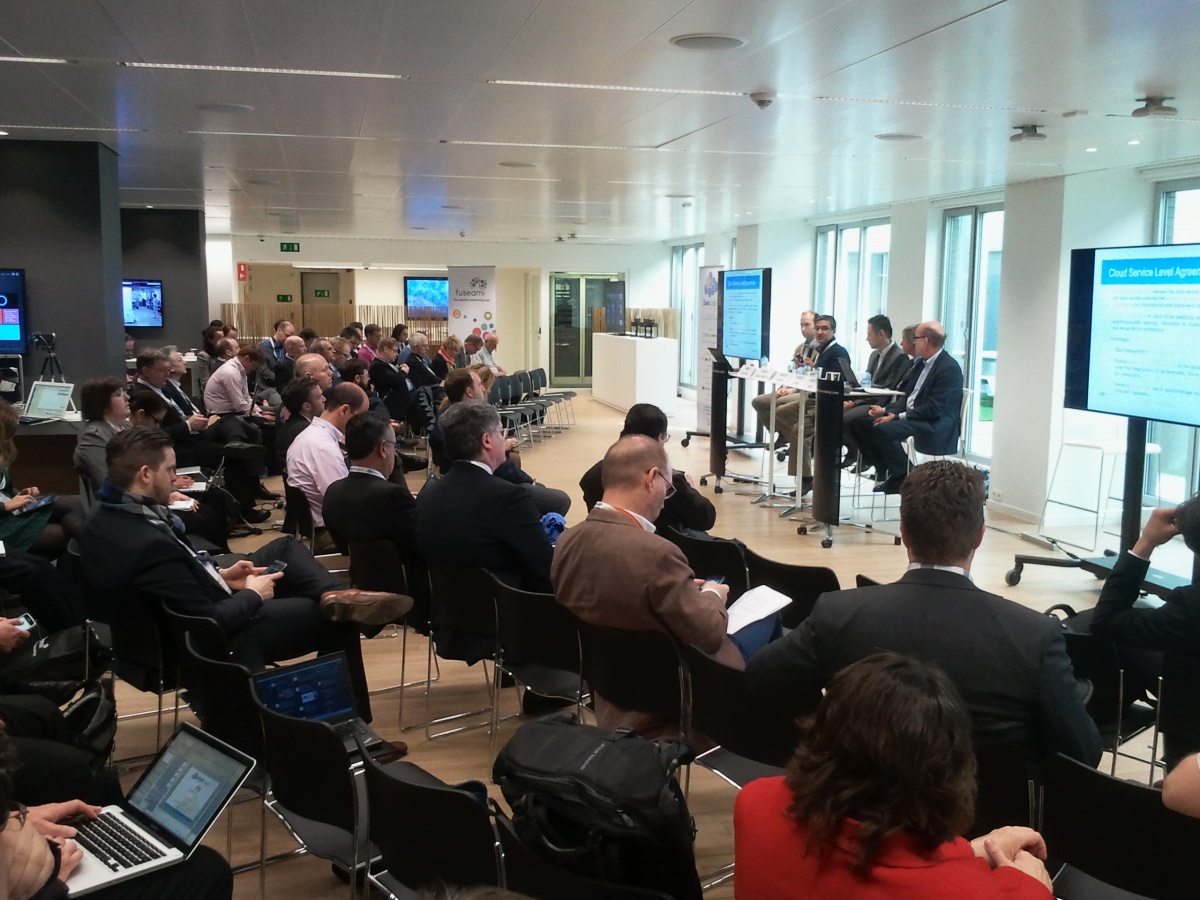
With cloud computing enabling new research collaborations and providing stimulus for economic growth, there was plenty to shout about at .
Gabriella Cattaneo, associate vice president of , presented . According to IDC's research, around three quarters of large European enterprises make use of cloud computing technologies today, as do just under two thirds of small and medium-sized enterprises (SMEs).
At around €6 billion (approximately $6.5 billion), total spending on cloud computing technologies in Europe currently equates to less than 5% of all IT spending. By the end of this decade, this figure is set to reach around €45 billion (approximately $48 billion), which is expected to represent over 10% of total IT spending. Today, most cloud-computing spending goes towards 'software-as a-service' solutions (SaaS). By contrast, in 2020 more than half of the money spent is expected to go towards private 'infrastructure-as-a-service' cloud solutions (IaaS).
"Cloud will contribute significantly to growth of the EU economy," says Cattaneo. IDC's research shows that cloud computing technologies could enable the creation of over 300,000 new companies by 2020 and could be responsible for over 0.7% of the European Union's total gross domestic product.
Security and legal concerns
Despite these projections, significant barriers to uptake remain. Pearse O'Donohue, head of highlighted some of the barriers faced by SME users in a panel discussion dedicated to cybersecurity. "There is still uncertainty and a lack of confidence in engaging with cloud," says O'Donohue, who pointed to . He and other panellists agreed that much emphasis needs to be placed on education, since cybercriminals often exploit human errors.
A legal perspective to cloud computing was provided by Kuan Hon, a research consultant to at at . She spoke at length about , which she argues could expose cloud service providers to liability in a range of situations, including for the security of personal data. Hon also emphasized the importance of businesses and citizens alike better equipping themselves to understand the legal implications of entering into cloud computing contracts. Read more from Hon in .
Exciting new European projects showcased
Several new projects, each of which has received funding under , were presented at the two-day event:
- Philippe Massonet, a scientific coordinator at , presented . This project aims to research and develop techniques to federate cloud network resources, and to derive the integrated management cloud layer that enables an efficient and secure deployment of federated cloud applications.
- Carmelo Ragusa, a senior systems engineer at , gave a demonstration about , which is working to develop a new generation of cloud computing platforms that will integrate heterogeneous hardware resources. Through this, the project partners hope to provide vastly increased performance with reduced energy consumption and lower cost.
- Davide Salomoni of gave a talk about the INDIGO-DataCloud project, which seeks to develop a new cloud software platform for the scientific community. Find out more about this on .
- was also highlighted at the event. Its objective is to set up a platform to help increase understanding of the issues surrounding procurement of cloud services in the public research sector. This work will be based on a set of use cases from scientific research. As well as promoting the cloud services market, the platform will support networking among procurers and will help them to understand the implications of ongoing work of Europe's cloud computing strategy.
A number of projects and initiatives that have received funding under were also discussed, including , , , , and others.
More new projects from the US and Brazil
Of course, cloud computing isn't just inspiring exciting new projects in Europe. Alan Sill, senior scientist at and vice president of standards for , presented two exciting new projects funded by .
- aims to provide a large-scale platform to the open research community that will enable exploration of transformative concepts in deeply programmable cloud services, design, and core technologies. The Chameleon testbed will be deployed at and and will consist of 650 multi-core cloud nodes and 5PB of total disk space. It also benefits from 100 gigabit-per-second connections connection between these two sites.
- supports the development of a large-scale distributed infrastructure that researchers will be able to use to construct many different types of clouds, experimenting with new architectures that will form the basis for the next generation of the world's computing platforms. It will be based at , , and , all in the US. Each site will have unique hardware, architecture, and storage features, and will be connected to the others via 100 gigabit-per-second connections on , which supports and other software-defined networking technologies.
- , which receives funding from both Europe and Brazil, was also featured at last week's event. This project aims to create an intercontinental federated e-infrastructure to offer the research community high-level scientific gateways and programming models. Within the framework of this project, the first event was held in October last year. Find out more about this .
Leading voices on cloud computing
"There was much interest at this year's event in '', with industry taking bold leaps on top of ," says Silvana Muscella, founder and managing director of , the company that organizes the Cloudscape events. "Cybersecurity was also a major topic in this year's agenda, as well as data privacy issues around law enforcement." Muscella continues: "These issues intertwined nicely with growing interest in 'the internet of things', making the event a perfect setting for all."
"Cloudscape has been sustaining high-level discussions about cloud in Europe for seven years now," adds Mario Campolargo, director for at . "This is very good to see".

